
1 cup of Flour
Vieng Chan, Laos
Tortillas were hard to come by in Vieng Chan. As a former French colony, you could find fresh French baguettes or other western bread products, but locating a pack of corn or flour tortillas remained a fool’s errand.
For the impending “Taco Tuesday” she was hosting at her house, the ever brilliant Sara devised an alternative: we’ll make our own flour tortillas. While not as widely available as kilos of rice, you could still find simple flour in the city center or across the Thai-Lao border in Nong Khai.
Sara’s festive taco treat was for our students from the National University. Many came from the remote provinces, but even if they were from the capital, most Lao students hadn’t -understandably- tasted international cuisines. Delighted to introduce them to other flavors and styles of cooking, Sara and the other expat teachers hosted cozy gatherings.
These warm, boisterous affairs blended perfectly with the many communal happenings filling the Lao calendar. From group picnics to weddings to even a large-scale house party to mark a professor’s son entering the Buddhist monastery, life in Laos operated in a collective rhythm.
I attended these lively events, at first reluctantly. My American clock had a short alarm. Eventually, I felt myself stripping away my individualistic guard rails and easing into the fluidity of Lao time. I wasn’t focused on producing or doing. I enjoyed the simplicity of just being.
I cherished how these soirees and homemade meals nourished connection. For my friends and colleagues preparing large-scale, multiple-plate menus, I admired their communal alchemy of transforming ingredients into edible sources of energy. We weren’t just absorbing calories; we were feeding ourselves with each others’ presence.
I pondered this as six of our students and I gathered around Sara’s kitchen table for Taco Tuesday. Gracefully, she spread the powdery flour across the surface and kneaded the dough into perfect round balls. Eagerly, the students and I joined in the playful tortilla-making, admiring the feel of the soft flour and watching it snow as the airy white dust fell from our hands.
Having lived off a steady diet of Anglo-Protestant individualism and the tiny breadcrumbs fallen from things like personal achievement or individual status, I could feel Laos altering my social diet and expanding my appetite. It was as if Laos activated dormant taste buds while also revealing a second stomach tucked inside my heart.
After we pan fried our homemade tortillas over Sara’s gas stove, we cooked the chicken, chopped the tomatoes, onions, and cilantro, then at last assembled our homemade tacos. When we gathered again at the kitchen table to enjoy the fruits of our shared labor, I thought of how countless cultures believe that the emotions we exude while cooking directly influences the flavors of the food.
Indeed, when I bit into my taco that night, I tasted laughter.
1 cup of milk
Manilla, Philippines
We were soon on route to our Airbnb outside of Manilla, but first, I read the text from my friend Kiley:
“Just picked up the rental car. Will be another 20 minutes. Can someone grab me an iced latte with oat milk?”
I sent a quick thumbs up emoji, then conferred with my other two friends waiting with me in our hostel lobby. I volunteered to pop down the street to grab the coffee while they watched our bags. It had been a late night of travel and early morning check-outs, so I felt more than obliged to grab the coffee. Kiley had painstakingly planned this festive friends’ trip and bravely volunteered to retrieve our rental car. If she could courageously drive the clogged, bustling streets of Manilla, I could easily provide caffeine sustenance.
I entered the muggy Manilla heat and strolled down the greasy pavement of the Makati district, beelining it towards the nearest Starbucks.
Thinking about her order as I navigated the uneven sidewalks, I wondered whether oat milk would be available. I knew in the US there’s always a wide range of options, but I wasn’t sure about here in the Philippines.
I traced my doubts to my undergraduate Intercultural Communication professor, Dr. Seward, who explained during a lecture the differences between individualism and collectivism. To illustrate her point, she gave an example of collectivism: lack of menu customization.
“If you were in Japan,” she explained, “and went to order a burger at a fast-food restaurant, you wouldn’t be able to ask for substitutes or alternatives and no removal of onions or pickles. You get what you get. Everyone gets the same option.”
Curious as to whether this facet of collectivism would manifest at a Starbucks in the Philippines, I arrived inside the sterile, air-conditioned store, gave my order, and asked for the milk options.
To my surprise, the patient barista explained that this Starbucks not only carries oat milk, but offers the full gauntlet: 2%, nonfat skim, whole milk, soy milk, almond milk, and coconut milk. It was a full menu of options you could -pun intended- milk.
Feeling victorious, I grabbed Kiley’s iced latte concoction and hurried back to our hostel.
Along Makati Avenue, I noted the other tell-tale Western chains in the hazy smog: McDonalds, KFC, Burger King, and Subway. They weren’t the dominating fixtures of the boulevard, but their presence felt unavoidable: the global food industry’s footprint redefining how everyone experiences our food supply chains, dining, and eating.
As I carried the iced latte and felt the wet condensation moisten my hand, I pondered on the wide range of milk options that this Starbucks carried and what this hyper-customization means, especially here in the Philippines.
On the one hand, for those of us with dairy sensitivities, it’s a miracle to have non-dairy options. It also feels reassuring when menus -whether at restaurants or at work functions- accommodate dietary needs for religious and health reasons, especially for obvious kosher or halal diets or sensitivities and allergies from shellfish, gluten, nuts, or dairy.
Offering this type of customization allows for inclusion, a necessity in parts of the world becoming more pluralistic, but is there a shadow side to this when it’s less about inclusion and more about profits?
I’m not militantly opposed to customization or purchasing what I like or need, but if my day is measured by the volume of choices made to fit my specific preferences, where in that time am I making decisions that consider larger units of people? How do I practice the habit of decision-making for the groups and communities I am a part of?
As I passed by the Subway and read the advert promoting breakfast burritos for 115 peos, the words “Build Your Better Breakfast,” struck a chord.
The marketing language specifically speaks solely to you, eclipsing our vision to see our lives as a collective we.
At Burger King, it’s “Have it your way.”
For the golden arches, it’s “I’m loving it.”
Imagine how different we’d approach life if we flipped a few pronouns and expanded the audience. How might we feel if our Amazon homepage read:
- “Amazon devices for all of us”
- “Deals for our local community”
- “More top picks for our neighborhood”
Even Starbucks marketing would have an entirely different spin if their latest iced Horchata oat milk shaken espresso ad read:
“Enjoy these cool favorites while we can.”
Nearing the hostel, I passed a homeless man in tattered clothes pushing a rusted bicycle on the edge of the street. A colorful Jeepney cruising at top speeds nearly grazed him.
Outside the hostel, a frail mother carrying her baby on her back wore crumbled sandals and had rings under her eyes.
I acknowledged my privilege in being able to ask “What kind of milk is best for my body?” but I also couldn’t help but consider, “How can we ensure that everyone in our neighborhood gets a glass of milk?”
1 Cup of Peaches
Murfreesboro, Tennessee
The same Intercultural Communication professor Dr. Seward described some cultures, like German or Korean, as coconuts. Their exterior is hard to crack, but once you’re in, you’re met with a soft interior. It could take years to crack the shell, but the breakthrough is worth it.
Conversely, Americans are like peaches.
They appear approachable with a soft, fuzzy exterior, but as you reach its core, you’re met with a rough, impenetrable pit.
“This is why,” Dr. Seward explained, turning to the international students in our class, “You might hear American students enthusiastically say, ‘Let’s meet for coffee’ when they see you, but they don’t always mean it.”
Unsure of how this worked, one student raised their hand, asking what she meant.
“Social currency in the US,” Dr. Seward observed, “is based on how friendly and pleasant you are (with of course a few exceptions). Often Americans are really sincere and they want to be friendly, but the other cultural values–like being busy and productive and having ambition- often outweigh this, so think of it as the same as when someone greets you in the US and asks ‘how are you?’ They don’t really mean for you to share your honest feelings, it’s just an expression. It’s the same with ‘let’s meet for coffee.’”
*****
Incheon, South Korea
I had just moved to South Korea and was making my rounds at work trying to get to know each of my colleagues.
When I uttered those five little words – “we should meet for coffee”- Julie, our director of finance and operations, grabbed my arm, looked me in the eye, and said “But no really, we should. Americans always say this, but don’t mean it. Let’s pick a time and meet or have lunch.”
Julie quickly circled around her desk to open her computer and combed through her work calendar for an open date.
I grinned, pulling out my phone to check my own calendar. I felt so grateful for Julie’s enthusiasm since many Koreans I had met were -despite my protests- worried that their English wasn’t good enough to carry a conversation.
”How does next Thursday at 10 sound?”
Julie scanned her calendar.
“Great. Let’s do it!”
“Julie,” I grinned even more, “I think this is the beginning of a beautiful friendship.”
Julie didn’t catch the iconic quote from Casablanca. As I came to learn over the course of the four years that I lived in South Korea, Julie wasn’t really interested in films or even music, but we both shared a deep love of books on personal growth and transformation.
In fact, visiting Julie in her office on the eighth floor to discuss what we were reading and learning became one of my social rituals I consistently followed in Korea. I hadn’t known it then, but we were essentially creating jeong.
Although jeong is somewhat difficult to directly translate, it can be described as a feeling of warmth and camaraderie that is not bound to an individual, but is shared. Cultivating this affection is key to getting things done and collaborating with colleagues, but not as a transactional obligation. You cultivate jeong because you are genuinely invested in each other’s shared humanity. Creating jeong simply means you are laying down stones while giving someone permission to walk across them.
What I enjoyed most from these jeong-building chats and shared meals with Julie was hearing her stories about her life. Of course, like everyone, Julie reflected the Korean society she was raised in, but she uniquely bucked many rigid societal norms, especially ones around gender roles. Not only was Julie the sole financial breadwinner, her husband was much younger, and Julie had her children much later than most Korean women, again proudly indifferent and unapologetic to the standards set by society.
Julie’s fierceness was contagious, but endearingly like a coconut, she had a very private gentle side she did not reveal to many.
One Saturday morning I received a text message from Julie asking if I was free and wanted to meet her at her reading spot in Michuhol Park. Eagerly I replied yes and walked the twenty minutes to the GPS location she sent.
When I saw her, Julie possessed a very calm, ethereal presence. She smiled when she spotted me and patted the bench gesturing me to sit and join her. Impressed that this corner of the park was quiet and not inundated with people, a hard reality to find given how densely populated Incheon is, I complimented Julie for claiming this as her reading spot.
Julie smiled more and said, “I don’t need much to be happy. I have my health and my family. And I have this spot, this little patch of nature.”
I breathed in deep and took in more of the surroundings, the quiet chirping of birds and the smell of earthy leaves, as autumn had just arrived on the peninsula.
Those days I had been suffering from severe discontentment and idleness, unsure of whether to stay in Korea or continue on my journey. I couldn’t pinpoint why I felt this way, but I knew it wasn’t a coincidence that my dear friend -who felt grounded, content, and at peace with her life- was showing me her private reading spot in the park. She was teaching me the wisdom in finding contentment in simplicity. To have gratitude for life’s small moments, like biting into a peach.
1 cup of sugar
Incheon, South Korea
Buying a whole pack of sugar seemed silly and excessive, especially since I only needed a spoonful or two to make my father’s marinara sauce.
This recipe, which I learned via my mom who had learned it from my father, is a day-long, simmering festive marriage between diced tomatoes, thick tomato paste, and dried oregano, basil, and parsley. To tame the tomatoes’ fussy acidity, it requires that complementary sweetness, so I caved and bought a kilo and a half of granulated white sugar.
What I would do with the remaining heft I wasn’t sure, as I committed myself to the appetizers and entrees for my birthday soirée, whereas, by the good grace of other lovely humans, desserts were covered by bakers who were leaps and bounds better at baking than me.
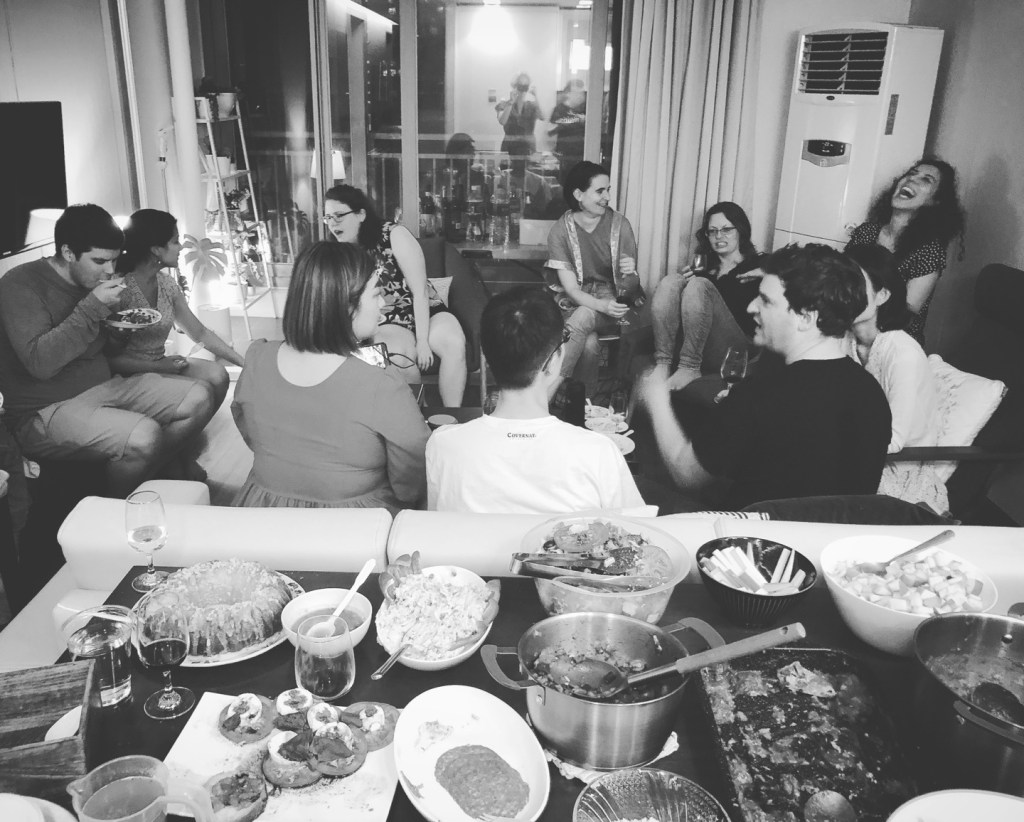
All of this was in preparation for a full-fledged Italian feast I had organized for my 31st birthday.
After a balloon-deflating 30th birthday spent with an ex in London, I vowed that I would not be alone and would make up for the previous year’s blunder. I would host a bountiful banquet and invite the many wonderful friends I had made since uprooting my life and moving to South Korea.
To honor their time and show my gratitude for their love (as I had become a proper mess and had spent the previous five months repairing my life from heartbreak and the throes of the pandemic), I wanted to treat them to the best meal of their life.
The menu first featured appetizers that included (all homemade) roasted red pepper and capers cream cheese dip, bruschetta with fresh basil, antipasto salad with fresh cut prosciutto, cheeses, and green olives, and Scilian caponata.
Then the main courses included: classic spinach and ricotta stuffed shells blanketed under my homemade marinara sauce, zesty chicken cacciatore, fettuccine alfredo with artisan, freshly grated parmesan, and a surf ‘n turf medley with bacon substituting pancetta mixed with a Gorgonzola-based red sauce and freshly sautéed shrimp.
It was ambitious.
It was insane.
And it was absolutely therapeutic to keep my mind and hands busy.
On the morning of the soiree, I woke early at five and began chopping and sauteing, as the marinara sauce needed the full runway of the day to simmer and morph into its life-affirming nectar. By the time five pm arrived, I looked at the clock the same way Henry Hill in Goodfellas kept scanning for the helicopter in the sky, as if time itself was stalking me and ready to arrest the fun.
But I was in a flow state. I was eager to feed and fill up on everyone’s satiated joy.
I loaded up my collapsible wagon with all of the dishes and pre-prep, then delicately rolled it to my friend Kiley’s, who graciously offered her apartment up for this shindig, as mine was too tiny.
When the clock struck seven, guests filled into Kiley’s apartment. The summer air swirled in from her balcony and the volume of voices grew.
The tables quickly filled with an abundance of beautiful desserts: tiramisu, chocolate cake, and a lemon pound cake.
I felt like a mad woman running from the stove to the sink to the counter, a whirling dervish with hot plates and knives. But I could hear the laughter and catch glimpses of folks chatting with folks they hadn’t met before.
Dean Martin’s “That’s Amore” spread like butter through the speaker. I poured myself a glass of red table wine and took a minute to take it all in. I hadn’t had a chance to grab a plate and I still had another twenty minutes to finish the red sauce for the surf n’ turf dish, but it didn’t matter.
The second stomach inside my heart was full.
1 Stick of Butter
Sevierville, Tennessee
The knock on the back door is just a formality. Willie, our eighty-year old neighbor from across the street, gives a gentle polite knock before entering my parents’ laundry room, finding his way into the kitchen, then settling into his designated spot at the end of our family’s extended kitchen table.
Upon hearing the knock, which always arouses my parents’ powder puff shih tzu, my mother routinely chimes, “Come on in, Willie!” then offers him a cup of coffee.
On this particular morning, my stepfather Tony was preparing Georgian cathead biscuits for breakfast. As a proud northern Georgia native, Tony enjoys flexing recipes he learned from his granny. Unlike my mom, who’s less inclined to share recipes while cooking, Tony’s eager for anyone to soak up his culinary lineage, especially since these simple staples combatted the poverty and hunger he had faced as a little boy.
For this particular dish, these fluffy pillows of doughy goodness were named not by any affiliation with felines, but because their gargantuan size compares to that of a cat’s head. Because they’re so filling, they’re not a regularly recurring breakfast staple, but every once in a while Tony will throw a stick of butter in the freezer the night before in preparation for the next morning’s breakfast.
Just as my mom set Willie’s mug of coffee in front of him and pulled out a chair to hear his latest woes with his girlfriend, Tony was explaining to me how frozen butter is easier to grade into the flour. After we mixed the ingredients, he then instructed me to rub my hands in flour and portion the mixed dough into circles on the pre-greased pan.
After I rinsed my hands, the subject of conversation switched to who all was attending my parents’ Easter Sunday meal.
“Well,” my mom reflected, “Ken and Dana are visiting her son, but Amelia said she’s coming, and Dan RSVP’d last night.”
“What about Pat and David?” Willie asked.
“I’m not sure but I’ll call them later today.”
“Well there’s always plenty of food,” Tony insisted, as if Pat and David were currently present and needed convincing.
I opened up the preheated oven and placed the biscuits on the middle rack.
“How long do we bake ‘em?” I asked while motioning to turn on the microwave’s timer.
“Now Anna May, you know the answer to that,” Tony retorted with a chuckle.
“Aw yes,” I recalled. In this house of loose and fast recipes, there were no exact measurements or strict rules. “You bake it until it’s done.”
“Exactly,” Tony beamed and sauntered toward the opposite end of the kitchen table.
I stood admiring the dynamic and familial conversation flowing between my parents and Willie.
Twenty years ago only silence filled this house like an abandoned museum. Crushed by our grief, we seldom had visitors and we hardly knew any of our neighbors. My father had just gotten sick when we first moved into this house, and he had died less than 2 years later.
My mother, who had lost her husband, was also raised by a German father who was indeed social, but like a coconut, it took time to break the exterior. The notion of neighbors having even more proximity to your life felt foreign, if not invasive.
Tony, on the other hand, grew up in a small rural town outside Atlanta where survival required social networks.
All to say, it took the colorful vibrancy of someone like Tony to make the rounds and forge connections with the neighbors (it helps too that he is a skilled contractor that can do almost any type of repair or remodel). In no time, he met nearly everyone on our block and embraced an open table policy. No one should eat alone or go without, especially during the holidays.
Now, this social contract doesn’t always play out seamlessly. And this isn’t to suggest an overly romanticized version of neighborly cohesion. There’s definitely been squalls. Or times where morning pop-ins for coffee are an inconvenience.
But looking at what’s been gained, I’ve learned my parents and I worship at a similar altar: a crowded table.
 Circuitous Wanderings
Leave a comment