
“To journey without being changed is to be a nomad.
To change without journeying is to be a chameleon.
To journey and to be transformed by the journey is to be a pilgrim.”
-Mark Nepo
July, 2022
My first time in Jeonju, a modest-sized hamlet of 600,000, was brief, a quick two-hour stopover while on a tour of Korea’s central region. At the time, I had just reached my one year milestone of living in Korea, and like many during the pandemic, I felt depleted, desperate for what travel -even a low-budget, guided weekend tour- can deliver: a fresh distraction from reality.
Jeonju fit the bill, not just for its signature choco pie– a confectionary dream of two rich cocoa cakes sandwiching a combo of chopped walnuts, jam, and fluffy whip cream- but for its street food and historic architecture.
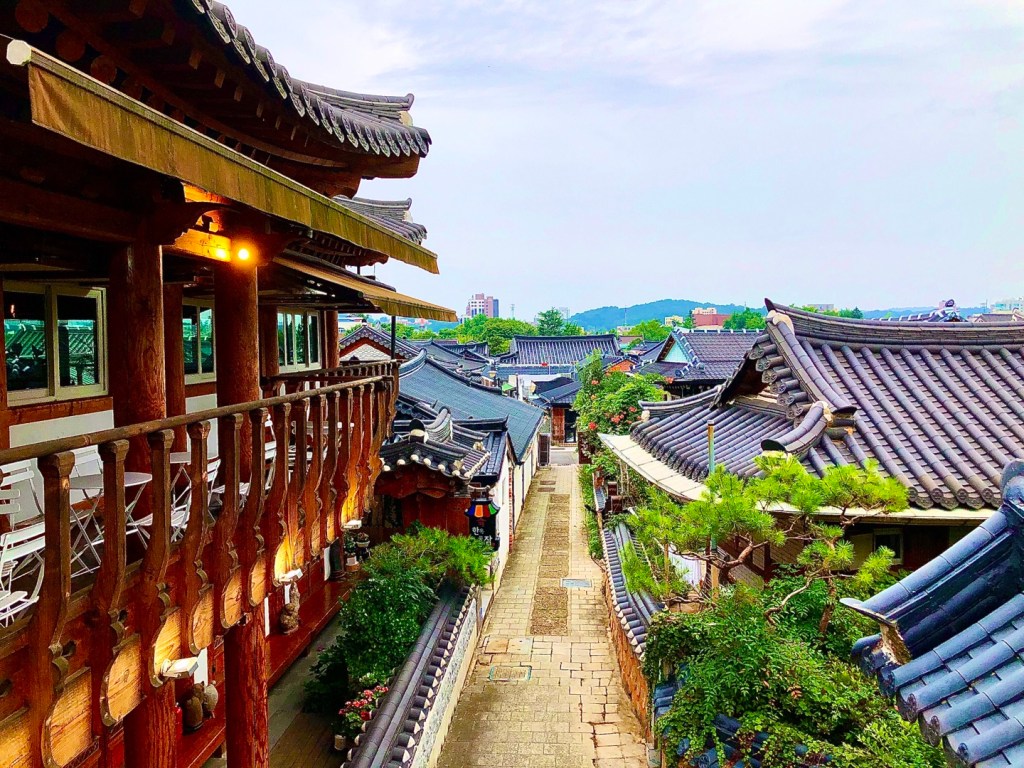
Jeonju’s signature hanok village, packed with over 700 homes crowned with traditional arched roofs that curve up toward the heavens, stands in stark contrast to my city’s bland and geometrically repetitive, suburban sky rise apartments (the likes of which resemble the innards of a stereo or a computer chip).
Wandering down Jeonju’s serpentine lanes, even for a brief two hours, my eyes widened and my mouth salivated from the aroma of sweet baked goods and deep-fried meats. I even felt fleeting impulses to sketch again, a hobby that had laid dormant during the pandemic and throughout my perpetual ennui of getting over a breakup and culture shock in Korea.
With hope renewed, I promised myself to someday revisit Jeonju when I could fully appreciate it.
Now, on this present-day trip, I’m nearing my three-year anniversary of living in Korea, only this time I feel sturdy.
Thinking about myself then, gloomy and forlorn, compared to now, hopeful, strong, and energetic, fits in a town known for its mix of old and new, where the dated, traditional hanok village sits among the familiar, modern traces of Korea: chain beauty stores, commercials cafes, steel buildings, and flowing traffic lanes.
With my sketchbook in hand and as I mosey along the same gray, cobblestoned streets I walked once before, passing tourists adorning elegant, colorful rented Hanbok attire and munching on sticks of grilled octopus blanketed in hot sauce and gooey cheese, I wonder: which parts of myself do I consider old and new?
Which aspects have I renovated? Taken a closer look to say, This requires the keen eye of a licensed contractor.
Most interestingly, are there parts of myself that were built to last?
Eyeing the couples strolling past me, I immediately reflect on my own dating habits, something I’m always trying to renovate.
Two years of therapy, a privilege I do not take lightly, have helped me pursue an internal excavation into my own mental architecture and hammer out a self-renovation. Hidden in my walls, I discovered several support beams that have, let’s say, been there all along, keeping my structural integrity intact.
These support beams are as follows:
BEAM NUMBER ONE:
Having lost my dad at eleven, my grief over him connects to the grief I’ve felt over failed relationships, and quite possibly, based on the work by Dr. Galit Atlas, this grief connects with the cumulative, generational abandonment women in my family have faced. My quest then is to observe these cycles and patterns with compassion and explore healthy ways to craft a different ending (i.e., not all love stories end in heartache).
BEAM NUMBER TWO:
I cannot distract or avoid my grief. As the sage Liz Gilbert once shared, “Grief is a bill you have to pay.” And I certainly have paid, but not before I did everything within my power to distract my grief with, quoting Peggy Fleming from the film Runaway Bride, “anything male that moves.”
This of course paired well with my international-travel-escapism that I adopted. Whisking away to different places instantly created new memories that I could easily pile over my grief.
Yet, like a wad of stepped-in gum, my grief stuck to the bottom of my soul no matter how far I traveled, inconveniently reminding me it’s not going anywhere, and it won’t change unless I do something about it.
BEAM NUMBER THREE:
Doing something about my grief meant befriending it, learning from it, and understanding it, but not just cognitively, in a cerebral, distanced way, as is often my approach.
I had to let myself feel it. Understand it through a physical, embodied relationship to feel its shape, weight, and texture. This aligns with what infamous, Oprah-endorsed, grief psychologist David Kessler attests: “You can’t heal what you can’t feel.”
BEAM NUMBER FOUR:
After two blitzkrieging break-ups and one sinister pandemic, the hardest lesson I’ve learned is this: facing hard emotions, like grief, doesn’t have to feel additionally difficult, scary, painful, or traumatic.
In the past, I imagined facing my hard emotions as me donning a heavy sword and stepping into a murky lake Beowulf-style to wrestle Grendel and slay his mother for fear that they would swallow me whole. My grief was an insatiable beast to slay.
This belief, however, is what basically spurred me to run from my grief. I needed a new framework.
Fusing Julie Cameron’s notion of fostering our inner artist child with Pema Chödrön’s approach to managing differences with others, I instead reframed my grief as my inner child needing compassion and patience. Instead of waging war with an innocent kid feeling idle, excluded, and in need of attention, I took my inner child of hard emotions out to play.
This may sound like another tactic to distract hard emotions, but it’s not. It’s adopting healthy ways to channel them so that they can run out of steam. As Chelsea Handler recently shared on Glennon Doyle’s podcast, it’s like letting a five-year old run outside until they exhaust themselves. Our pain has the same kinetic energy, as does my grief. If I don’t take her out to play, she’s going to finger paint my walls or flush my keys down the toilet.
Of course, because play is so specific and personal, I needed to identify what types of play outlets best serve me.
BEAM NUMBER FIVE
Once I befriended my grief, I learned how to play with her in a way that reflects my own true nature, something that we, as Martha Beck assures, “can’t outfox.”
My truest self, yearning to live publicly and freely without borders or constraints, will gently whisper to me what she needs in order to heal. Oprah calls this life’s whispers. The challenge, as all the greats have taught, is cultivating a busy-free, calming quiet so that I can hear what my body needs for healing. Otherwise, these whispers amplify into loud, pleading, deafening roars.
Although I didn’t know it at the time, my last break-up and the emotional fallout was my major deafening-roar/wake up call to once and for all still myself and turn inward.
Right around the time this occurred, a dear friend surprised me with the book The Artist’s Way, a twelve-week guide for blocked creatives to rediscover themselves and rekindle their pursuits for living a creative life.
This dear friend, and God love him if he’s reading this, assured me that I wasn’t stuck with my love life or my career; I was just in between chapters.
From those twelve weeks, I learned to take myself on small, but fun and indulgent self-dates, to prioritize and protect my time, to practice the sacred habit of morning journaling, and to block myself from the world’s negative crazy-makers.
By doing this, I essentially created enough momentum to turn the pages towards my life’s next chapter. I discovered through that process that creative outlets –writing, painting, sketching– or traveling for learning and self-discovery are my healthy play tactics. Through these outlets my grief can evolve, and I can heal.
As I reflect on these five support beams, and how they’ve kept a proverbial roof over me, I take note of the change in the air. Right now, we’re in the humid rainy season, hence most days showcase bruise-colored cumulonimbus clouds, ready to dump water at any moment.
Feeling large droplets graze the crown of my head, I quickly make my way under an awning at a nearby local brewery. After ordering a citrusy double IPA, I cozy up at a vacant table by the black iron railing and begin munching on the complimentary popcorn served in a small tin bowl.
Nestled in my chair, I feel deep gratitude for the serenity that follows after months -years even- of hard-ass internal demolition. But even with the years that I neglected tending to my internal home, these were detours that I don’t regret taking. After all, this is an art space called Circuitous Wanderings. My wanderings have, in the end, led me back to myself.
In addition to discovering my internal pillars of strength, I’ve also painstakingly wiped the dust from my windows so that now sunlight can stretch its rays inside me, and I can view the world with crisp clarity.
Noting this, I peer out at the bustling street the brewery sits on. Despite the drizzle and the ashen somber sky, the hanok village continues to emit its bouncy, kitschy, fun verve. Little toddlers decked out in head to toe swim gear splash in the ankle-deep, water-flowing, stone ditches. Electric scooters cart families and couples along the bumpy cobblestone streets. Teenagers with sweaty, iced coffee drinks in hand snap selfies and pose in front of the stone facades of buildings, the wooden hexagon pavilions, and the granite benches. Grandparents sit nearby, carefully watching with quiet amusement over their own progeny.
Now that I feel so comfortably grounded, unwilling to hide from or distract my grief with men or aimless travel, where do I journey to next?
Who will I meet?
Which roads are calling me to wander?
 Circuitous Wanderings
Leave a comment